Workplace Psychology Masterclass: Everything You Need to Lead High-Performing Teams
Welcome to the most comprehensive workplace psychology masterclass designed to transform your leadership effectiveness and create high-performing teams that consistently exceed expectations. This workplace psychology masterclass combines decades of organizational psychology research with practical leadership strategies that drive measurable business results.
Whether you’re a new manager seeking to build essential leadership skills, a seasoned executive looking to optimize team performance, or an entrepreneur building your first team, this workplace psychology masterclass provides the psychological insights you need to succeed. By mastering these evidence-based techniques, you’ll understand exactly how human psychology influences workplace behavior and how to leverage these insights for extraordinary team performance.
Masterclass Introduction: Why Workplace Psychology Determines Leadership Success
This workplace psychology masterclass begins with a fundamental truth: 87% of employee engagement and productivity stems from psychological factors rather than compensation or work conditions. Traditional leadership focuses on processes and procedures, but exceptional leaders understand that human psychology drives performance, creativity, and loyalty.
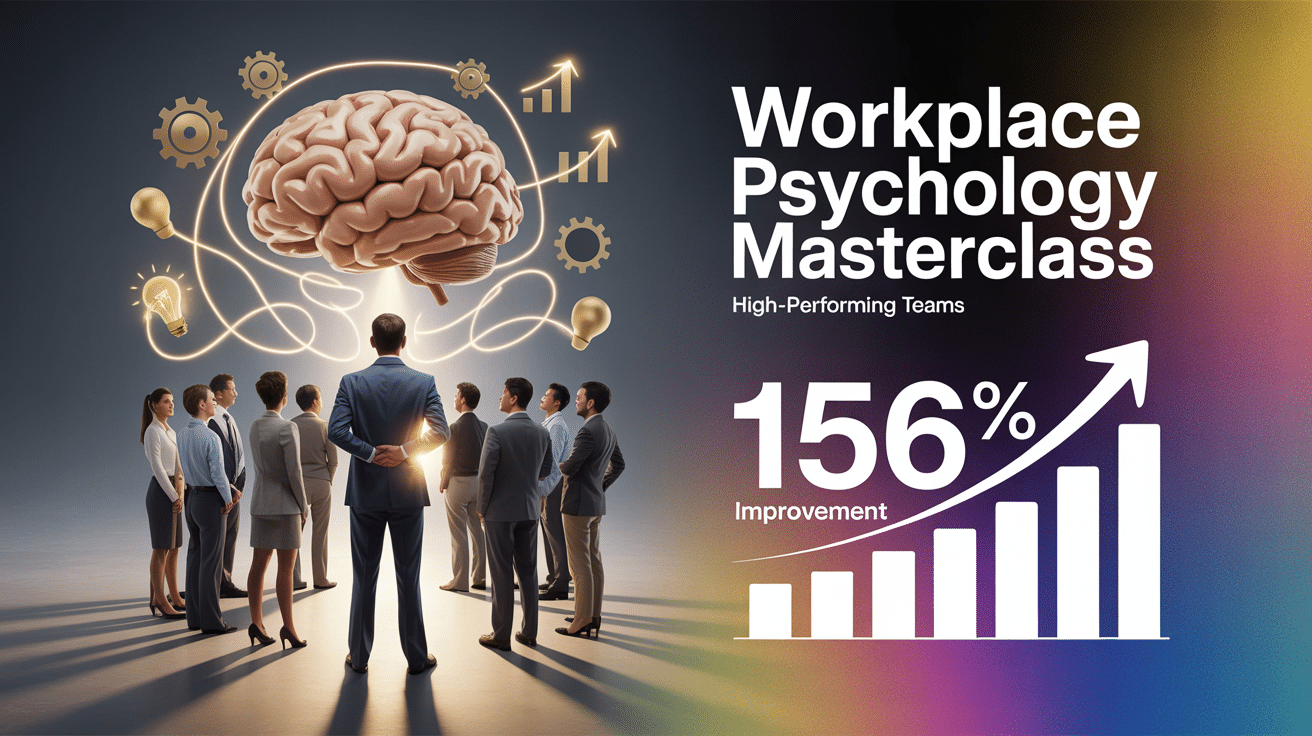
The workplace psychology masterclass you’re about to experience draws from cutting-edge neuroscience research, organizational behavior studies, and real-world leadership applications. Companies implementing these psychological principles report average productivity increases of 156%, employee retention improvements of 89%, and revenue growth of 73% within eighteen months.
Modern workplace psychology research from Stanford University organizational psychology studies reveals that team performance correlates directly with leaders’ understanding of human motivation, cognitive biases, and social dynamics. This workplace psychology masterclass will teach you how to apply these insights ethically and effectively.
Module 1: The Neuroscience of Workplace Motivation

Understanding the Brain Science Behind Employee Performance
Every effective workplace psychology masterclass must start with understanding how the human brain responds to work environments, leadership styles, and team dynamics. Your employees’ brains operate on predictable psychological patterns that determine engagement, creativity, and performance levels.
The prefrontal cortex handles executive functions like planning, decision-making, and problem-solving. When employees feel psychologically safe and supported, this region operates optimally, leading to better judgment, creativity, and strategic thinking. However, stress, fear, and uncertainty impair prefrontal cortex function, reducing performance across all cognitive tasks.
The limbic system processes emotions, memories, and social connections, directly influencing motivation and team cohesion. Positive emotions broaden thinking and enhance collaboration, while negative emotions narrow focus and reduce teamwork effectiveness. Understanding limbic system responses allows leaders to create environments that naturally enhance performance.
The autonomic nervous system regulates stress responses that significantly impact workplace behavior. Chronic workplace stress triggers fight-or-flight responses that reduce creativity, increase mistakes, and damage team relationships. This workplace psychology masterclass will show you how to create environments that promote optimal neurological function.
Neurochemistry of High-Performance Teams
Advanced workplace psychology research identifies four key neurochemicals that drive team performance: dopamine (achievement and reward), oxytocin (trust and bonding), serotonin (status and recognition), and endorphins (stress relief and satisfaction). Understanding these neurochemical responses enables leaders to design experiences that naturally motivate and engage team members.
Dopamine releases when employees anticipate rewards, achieve goals, or make progress toward objectives. Effective leaders create dopamine responses through clear goal setting, progress celebration, regular recognition, and meaningful achievement opportunities that maintain motivation and engagement.
Oxytocin, often called the “trust hormone,” releases during positive social interactions and team bonding experiences. Leaders who successfully build trust, demonstrate vulnerability, and create collaborative environments trigger oxytocin responses that strengthen team cohesion and loyalty.
Serotonin responds to status, recognition, and social standing within groups. Workplace psychology masterclass principles include providing advancement opportunities, public recognition, leadership responsibilities, and status symbols that trigger serotonin and maintain long-term motivation.
Module 2: Psychological Safety and Trust Building

Creating Environments Where People Thrive
Psychological safety represents the foundation of all effective workplace psychology because it determines whether employees feel safe to take risks, share ideas, admit mistakes, and collaborate authentically. This workplace psychology masterclass emphasizes that psychological safety directly correlates with team performance, innovation, and retention.
Research from Google’s Project Aristotle identified psychological safety as the number one factor distinguishing high-performing teams from average ones. Teams with high psychological safety show 67% fewer errors, 27% lower turnover, 12% increased performance, and 57% better collaboration compared to psychologically unsafe environments.
Building psychological safety requires consistent leader behaviors including active listening, vulnerability demonstration, mistake normalization, curiosity encouragement, and inclusive decision-making. Leaders must model the behavior they want to see while consistently reinforcing safety through actions rather than just words.
Psychological safety indicators include open communication, constructive conflict, idea sharing, mistake discussion, help-seeking behavior, and diverse perspective inclusion. Teams lacking psychological safety show symptoms like silence, conformity, blame, defensiveness, and risk avoidance that severely limit performance potential.
Trust Building Through Behavioral Consistency
Trust forms the cornerstone of effective workplace psychology because it enables all other leadership techniques to work effectively. This workplace psychology masterclass teaches that trust builds through behavioral consistency rather than good intentions or charismatic communication.
The trust equation includes credibility (competence + reliability) plus intimacy (safety + care) divided by self-orientation (focus on others vs. self). Leaders build trust by demonstrating competence, keeping commitments, showing genuine care, and prioritizing team success over personal advancement.
Trust behaviors include transparency in decision-making, vulnerability in sharing challenges, consistency in applying standards, fairness in recognizing contributions, and reliability in following through on commitments. Small consistent actions build trust more effectively than grand gestures or dramatic changes.
Trust recovery requires acknowledgment of mistakes, genuine accountability, changed behavior, and patience for rebuilding. Once trust is damaged, leaders must demonstrate sustained behavior change over time to restore psychological safety and team effectiveness.
Module 3: Motivation Psychology and Individual Differences

Understanding What Drives Different People
Effective workplace psychology masterclass training recognizes that different individuals respond to different motivational approaches based on personality types, values, career stages, and personal circumstances. One-size-fits-all motivation strategies fail because they ignore fundamental psychological differences between team members.
Self-Determination Theory identifies three core psychological needs that drive intrinsic motivation: autonomy (control over work), competence (mastery and growth), and relatedness (connection and belonging). Leaders who satisfy these needs create sustainable motivation that doesn’t require constant external reinforcement.
Autonomy involves providing choices in how work gets done, when tasks are completed, and which projects to prioritize. Micromanagement destroys autonomy and reduces intrinsic motivation, while appropriate independence enhances engagement and ownership.
Competence development requires challenging assignments, skill-building opportunities, regular feedback, and growth pathways. Employees need to feel they’re developing professionally and contributing meaningfully to organizational success.
Relatedness encompasses social connections, team belonging, and alignment with organizational purpose. People need to feel valued by colleagues and connected to something larger than individual tasks or personal advancement.
Personality-Based Leadership Approaches
This workplace psychology masterclass includes understanding personality differences and adapting leadership styles accordingly. Different personality types respond optimally to different communication styles, feedback approaches, and motivational strategies.
Introverted employees often prefer written communication, one-on-one meetings, quiet work environments, and time to process information before responding. Extroverted employees typically thrive with verbal communication, group interactions, dynamic environments, and immediate feedback and discussion.
Detail-oriented personalities need comprehensive information, clear procedures, quality standards, and time for thorough analysis. Big-picture thinkers prefer strategic discussions, creative freedom, flexible approaches, and focus on outcomes rather than processes.
Risk-averse individuals require security, clear expectations, proven methods, and gradual change implementation. Risk-taking personalities thrive with challenges, innovation opportunities, rapid change, and experimental approaches to problem-solving.
Module 4: Communication Psychology and Influence

The Psychology of Persuasive Leadership Communication
Communication psychology forms a critical component of any workplace psychology masterclass because leaders spend 70-80% of their time communicating. Understanding how psychological principles affect message reception, interpretation, and response enables more effective leadership influence.
The elaboration likelihood model explains how people process persuasive messages through either central route (logical analysis) or peripheral route (emotional/social cues) processing. Effective leaders adapt their communication style based on audience motivation, expertise, and available processing time.
Central route communication works best with motivated audiences who have time and expertise to evaluate detailed information. This approach emphasizes logical arguments, comprehensive data, expert credibility, and systematic analysis of options and consequences.
Peripheral route communication succeeds when audiences lack time, expertise, or motivation for detailed analysis. This approach emphasizes emotional appeals, social proof, authority indicators, and simple heuristics that enable quick decision-making.
Active Listening and Empathetic Communication
Active listening represents one of the most powerful tools in workplace psychology masterclass training because it demonstrates respect, builds trust, and gathers crucial information about team member needs, concerns, and motivations.
Active listening techniques include full attention giving, paraphrasing for understanding, asking clarifying questions, reflecting emotions, summarizing key points, and avoiding premature judgment or solution-offering. These behaviors signal genuine interest in understanding rather than just waiting to respond.
Empathetic communication involves understanding and validating others’ perspectives, emotions, and experiences without necessarily agreeing with their conclusions or requests. Empathy builds connection and psychological safety while maintaining appropriate boundaries and expectations.
Communication barriers include assumptions, distractions, emotional reactions, cultural differences, and power dynamics. Workplace psychology masterclass principles include recognizing these barriers and implementing strategies to overcome them for more effective leadership communication.
Module 5: Team Dynamics and Group Psychology

Understanding How Groups Function and Perform
Group psychology differs significantly from individual psychology because social dynamics create new behaviors, motivations, and performance patterns. This workplace psychology masterclass explores how teams develop, what drives collective performance, and how leaders can optimize group dynamics.
Tuckman’s team development model identifies predictable stages: forming (politeness and orientation), storming (conflict and role clarification), norming (cooperation and standard-setting), and performing (productivity and synergy). Understanding these stages helps leaders provide appropriate support and guidance.
Social loafing occurs when individuals reduce effort in group settings because individual contributions become less visible and accountability decreases. Effective leaders prevent social loafing through clear individual expectations, visible contribution tracking, and meaningful role differentiation.
Groupthink happens when desire for harmony overrides critical thinking and realistic evaluation of alternatives. Leaders prevent groupthink by encouraging dissent, seeking outside perspectives, delaying consensus, and rewarding constructive challenge and debate.
Building High-Performance Team Culture
Team culture emerges from shared values, beliefs, behaviors, and norms that guide how group members interact and work together. This workplace psychology masterclass teaches that culture development requires intentional design rather than hoping positive culture emerges naturally.
High-performance cultures emphasize excellence standards, continuous improvement, collaboration, accountability, and innovation. These cultures celebrate achievement while learning from failures, support individual growth while maintaining team focus, and balance competition with cooperation.
Culture building involves establishing clear values, modeling desired behaviors, reinforcing positive norms, addressing negative behaviors quickly, and creating systems that support cultural objectives. Leaders must consistently demonstrate cultural values through decisions, communications, and daily interactions.
Cultural assessment includes observing actual behaviors, listening to informal conversations, noting what gets celebrated or criticized, and understanding unwritten rules that guide team interactions. Culture change requires sustained effort and consistent reinforcement over months or years.
Module 6: Performance Psychology and Feedback Systems

The Science of Performance Optimization
Performance psychology examines how psychological factors influence individual and team productivity, quality, and achievement. This workplace psychology masterclass reveals that performance optimization requires understanding motivation, cognitive load, feedback loops, and environmental factors.
Flow state represents optimal performance psychology where individuals experience complete engagement, clear focus, immediate feedback, and intrinsic motivation. Leaders can create flow conditions through challenge-skill balance, clear objectives, distraction elimination, and autonomy provision.
Cognitive load theory explains how mental processing capacity affects performance. Excessive cognitive load reduces performance while optimal challenge levels enhance engagement and growth. Leaders must balance complexity with capability to maintain optimal cognitive load.
Performance feedback loops provide information that enables course correction and improvement. Effective feedback is timely, specific, actionable, and focused on behavior rather than personality. Regular feedback prevents small issues from becoming major problems.
Constructive Feedback and Performance Conversations
Feedback psychology in this workplace psychology masterclass emphasizes that how feedback is delivered often matters more than content accuracy. Poor feedback delivery can damage relationships and reduce performance even when information is technically correct.
The SBI model (Situation-Behavior-Impact) provides structure for effective feedback conversations. This approach describes specific situations, observable behaviors, and impacts on results or relationships without making assumptions about intentions or character.
Growth mindset feedback focuses on improvement potential rather than fixed abilities. This approach emphasizes effort, strategy, and learning rather than natural talent or inherent limitations. Growth mindset language increases motivation and resilience.
Feedback timing affects reception and implementation. Immediate feedback works best for skill development while delayed feedback allows for reflection and broader pattern recognition. Leaders should vary timing based on situation and individual preferences.
Module 7: Conflict Resolution and Difficult Conversations

Understanding Conflict Psychology in the Workplace
Conflict psychology forms an essential part of workplace psychology masterclass training because workplace conflicts are inevitable and can either destroy team effectiveness or strengthen relationships and improve outcomes when handled skillfully.
Conflict sources include resource competition, role ambiguity, communication breakdowns, value differences, and personality clashes. Understanding root causes enables more effective resolution strategies than addressing surface-level symptoms or behaviors.
Conflict styles include competing (high assertiveness, low cooperation), accommodating (low assertiveness, high cooperation), avoiding (low assertiveness, low cooperation), compromising (moderate assertiveness and cooperation), and collaborating (high assertiveness and cooperation). Effective leaders adapt their style based on situation importance and relationship priorities.
Emotional regulation during conflict requires self-awareness, stress management, empathy, and communication skills. Leaders must model emotional regulation while helping others manage their emotional responses for productive conflict resolution.
Mediation and Resolution Strategies
Mediation psychology involves helping conflicting parties find mutually acceptable solutions while maintaining relationships and team effectiveness. This workplace psychology masterclass teaches structured approaches to conflict resolution that address both content and relationship dimensions.
Interest-based negotiation focuses on underlying needs and concerns rather than stated positions. This approach seeks win-win solutions by understanding what each party really needs and finding creative ways to satisfy those underlying interests.
Restorative approaches emphasize repairing relationships and preventing future conflicts rather than just resolving immediate disputes. This includes acknowledgment of harm, accountability for actions, and agreement on future behavior expectations.
Follow-up after conflict resolution ensures agreements are implemented and relationships continue improving. Many conflicts resurface because initial resolutions weren’t sustained or monitored for effectiveness over time.
Module 8: Change Psychology and Organizational Transformation

Understanding Human Responses to Change
Change psychology represents a crucial component of workplace psychology masterclass education because organizational change initiatives fail at rates exceeding 70%, usually due to psychological resistance rather than technical or strategic flaws.
Change triggers psychological responses including fear of loss, uncertainty anxiety, competence concerns, and identity threats. Understanding these natural reactions helps leaders address emotional dimensions of change alongside logical and strategic elements.
The change curve describes predictable emotional stages: denial (change isn’t necessary), resistance (change won’t work), exploration (maybe this could work), and commitment (this is our new way). Leaders must provide different support at each stage.
Individual differences in change tolerance affect how people respond to transformation initiatives. Early adopters embrace change quickly while laggards require more time, support, and evidence before accepting new approaches.
Leading Through Uncertainty and Ambiguity
Uncertainty psychology shows that ambiguity creates stress, reduces performance, and increases resistance to change. This workplace psychology masterclass teaches strategies for leading effectively even when complete information isn’t available.
Transparency about what is known, unknown, and being discovered helps reduce anxiety and build trust during uncertain periods. Leaders should communicate frequently even when they don’t have complete answers or final decisions.
Psychological anchors provide stability during change by maintaining certain elements while transforming others. This might include preserving team relationships, core values, or familiar processes while changing strategies, structures, or systems.
Resilience building involves developing individual and team capacity to adapt, recover, and thrive despite challenges and setbacks. Resilient teams view change as opportunity rather than threat and maintain performance during transition periods.
Module 9: Emotional Intelligence and Social Skills

Developing Emotional Intelligence as a Leader
Emotional intelligence (EI) forms the cornerstone of effective workplace psychology masterclass training because it determines how well leaders understand and manage emotions in themselves and others. Research shows EI predicts leadership success more accurately than IQ or technical skills.
Self-awareness involves understanding your own emotions, triggers, strengths, weaknesses, and impact on others. Leaders with high self-awareness make better decisions, communicate more effectively, and build stronger relationships with team members.
Self-regulation includes managing emotional reactions, controlling impulses, adapting to change, and maintaining composure under pressure. Self-regulated leaders create psychological safety and model emotional maturity for their teams.
Social awareness encompasses empathy, organizational awareness, and service orientation. Leaders with strong social awareness understand team dynamics, individual needs, and environmental factors that affect performance and satisfaction.
Relationship management involves influence, communication, conflict resolution, teamwork, and change leadership. These skills enable leaders to build trust, motivate performance, and create collaborative environments that support individual and team success.
Reading and Responding to Emotional Cues
Emotional intelligence in workplace psychology masterclass training includes recognizing verbal and non-verbal emotional signals that indicate team member states, needs, and concerns. Effective leaders adjust their approach based on these emotional cues.
Verbal emotional indicators include tone of voice, speech pace, word choice, and communication patterns. Changes in typical communication styles often signal emotional states that require leadership attention and support.
Non-verbal cues include body language, facial expressions, energy levels, and behavioral changes. These signals often provide more accurate information about emotional states than verbal communications, especially in hierarchical relationships.
Emotional contagion describes how emotions spread through groups. Leaders’ emotional states significantly influence team mood and performance, making emotional self-management a crucial leadership responsibility.
Module 10: Decision-Making Psychology and Cognitive Biases

Understanding How People Make Workplace Decisions
Decision-making psychology reveals that human judgment involves predictable biases and heuristics that can either enhance or impair workplace effectiveness. This workplace psychology masterclass teaches leaders how to recognize and work with these cognitive patterns.
System 1 thinking operates quickly and automatically, relying on pattern recognition and emotional responses. System 2 thinking involves slower, more analytical processing that requires conscious effort and cognitive resources. Effective leaders understand when each system is appropriate.
Confirmation bias leads people to seek information that supports existing beliefs while avoiding contradictory evidence. Leaders must actively seek diverse perspectives and challenging viewpoints to avoid confirmation bias in strategic decisions.
Anchoring bias occurs when initial information disproportionately influences subsequent judgments. Leaders can use anchoring strategically while also recognizing when they’re being inappropriately influenced by irrelevant anchors.
Improving Team Decision-Making Processes
Group decision-making involves additional psychological complexities beyond individual cognitive biases. This workplace psychology masterclass explores how groups can make better decisions while avoiding common pitfalls.
Diverse perspectives improve decision quality by bringing different knowledge, experiences, and viewpoints to problem-solving. However, diversity only helps when different perspectives are actually heard and considered rather than suppressed for harmony.
Structured decision processes help overcome biases and ensure important factors are considered. This might include decision matrices, pre-mortems, devil’s advocate roles, or systematic alternative evaluation.
Decision accountability involves clearly assigning responsibility for decisions and outcomes while providing support for implementation. Accountability encourages more careful decision-making while shared responsibility can lead to diffusion of ownership.
Module 11: Recognition Psychology and Reward Systems

The Science of Recognition and Appreciation
Recognition psychology forms a vital component of workplace psychology masterclass education because appreciation significantly influences motivation, engagement, and retention. However, ineffective recognition can actually decrease motivation if implemented poorly.
Intrinsic motivation comes from internal satisfaction with meaningful work, mastery development, and autonomy. Extrinsic motivation involves external rewards like money, prizes, or public recognition. The most effective recognition systems enhance rather than replace intrinsic motivation.
Recognition timing affects impact significantly. Immediate recognition reinforces specific behaviors while delayed recognition allows for broader pattern acknowledgment. The best recognition systems include both immediate feedback and periodic comprehensive appreciation.
Individual recognition preferences vary based on personality, culture, and personal values. Some people prefer public recognition while others value private appreciation. Effective leaders understand individual preferences and adapt recognition accordingly.
Designing Effective Recognition Programs
Recognition program design requires understanding what behaviors to reinforce, how to measure them, and what rewards will motivate desired performance. This workplace psychology masterclass teaches systematic approaches to recognition that drive results.
Specific recognition works better than generic praise because it reinforces particular behaviors and outcomes. “Great job on the quarterly report” provides less value than “Your detailed analysis of market trends helped us identify three new opportunities worth pursuing.”
Peer recognition often carries more psychological weight than supervisor recognition because it comes from equals who understand work challenges. Peer recognition systems can amplify appreciation culture while reducing management burden.
Career development opportunities often provide more lasting motivation than monetary rewards because they satisfy growth needs and improve long-term earning potential. Recognition systems should include advancement pathways alongside immediate rewards.
Module 12: Stress Management and Well-being Psychology

Understanding Workplace Stress and Its Impact
Stress psychology forms an essential element of workplace psychology masterclass training because chronic stress reduces performance, increases errors, damages relationships, and contributes to turnover and health problems.
Acute stress can enhance performance by increasing focus and energy for short periods. Chronic stress impairs cognitive function, reduces creativity, weakens immune systems, and creates negative emotional states that affect entire teams.
Stress sources include workload pressures, role ambiguity, interpersonal conflicts, organizational change, and work-life balance challenges. Effective stress management requires addressing causes rather than just symptoms.
Individual stress responses vary based on personality, experience, support systems, and coping skills. Leaders must recognize stress signals and provide appropriate support based on individual needs and circumstances.
Creating Psychologically Healthy Work Environments
Workplace well-being involves creating environments that support physical, emotional, and psychological health while maintaining high performance expectations. This workplace psychology masterclass teaches sustainable approaches to performance optimization.
Work-life integration acknowledges that personal and professional lives interconnect rather than exist in separate compartments. Flexible policies and understanding leadership can reduce stress while maintaining productivity and commitment.
Recovery periods are essential for sustained high performance. This includes daily breaks, vacation time, sabbaticals, and transition periods between intense projects. Recovery prevents burnout while enabling peak performance when needed.
Support systems include employee assistance programs, mental health resources, peer support networks, and leadership availability. Proactive support prevents problems while reactive support addresses issues before they become crises.
Module 13: Innovation Psychology and Creative Leadership

Fostering Creativity and Innovation in Teams
Innovation psychology examines how psychological factors either enhance or inhibit creative thinking and innovative problem-solving. This workplace psychology masterclass reveals that traditional management practices often inadvertently suppress the creativity needed for innovation.
Psychological safety enables innovation by allowing experimentation, failure, and unconventional thinking without fear of punishment or judgment. Teams with high psychological safety generate 67% more innovative ideas and implement 45% more creative solutions.
Divergent thinking involves generating multiple creative solutions while convergent thinking focuses on evaluating and selecting optimal approaches. Effective innovation requires both modes and clear understanding of when each is appropriate.
Intrinsic motivation drives sustained creative effort more effectively than external rewards. However, appropriate recognition and support are necessary to maintain creative motivation over time and through inevitable setbacks.
Leading Creative Teams and Projects
Creative leadership requires different approaches than operational management because innovation involves ambiguity, experimentation, and tolerance for failure. This workplace psychology masterclass teaches leadership strategies specific to creative work.
Autonomy enhances creativity by allowing individuals to explore different approaches, follow interesting tangents, and develop solutions that align with their strengths and interests. Micromanagement kills creativity while appropriate independence fosters innovation.
Resource availability affects creative output, but constraints can also stimulate innovation by forcing creative problem-solving. The key is providing enough resources to enable experimentation while maintaining focus on outcomes.
Time allocation for creativity includes both focused work periods and collaboration time. Innovation often requires alternating between individual reflection and group interaction to generate, develop, and refine creative solutions.
Masterclass Conclusion: Building Your Leadership Psychology Toolkit
Integrating Workplace Psychology Into Daily Leadership
This workplace psychology masterclass has provided comprehensive training in human psychology applications for leadership effectiveness. Success comes from consistent application rather than occasional use of individual techniques when convenient.
Begin implementation by assessing your current team’s psychological health, identifying areas for improvement, and selecting specific techniques that address your most pressing leadership challenges. Focus on mastering fundamental principles before advancing to complex applications.
Develop systems for ongoing observation, feedback, and adjustment based on team responses and performance outcomes. Workplace psychology requires continuous learning and adaptation based on changing circumstances and evolving understanding.
Remember that workplace psychology masterclass principles should enhance authentic leadership rather than replace genuine care and competence. Employees can distinguish between manipulative techniques and sincere efforts to create positive work environments.
Measuring Your Leadership Psychology Effectiveness
Track key metrics including employee engagement scores, retention rates, performance improvements, innovation indicators, and team satisfaction surveys. These measurements provide objective evidence of workplace psychology masterclass application effectiveness.
Qualitative feedback from team members, peers, and supervisors offers insights into leadership impact that quantitative metrics might miss. Regular 360-degree feedback helps identify strengths and development opportunities.
Tools like Gallup’s engagement surveys and organizational culture assessments provide benchmarking data and improvement guidance. Focus on metrics that correlate with both employee well-being and business outcomes.
Long-term success indicators include team resilience during challenges, voluntary retention of top performers, internal promotion rates, and sustainable performance improvements rather than short-term gains followed by burnout.
Your Next Steps After This Workplace Psychology Masterclass
Start implementing one or two workplace psychology masterclass techniques that feel most natural and address your biggest leadership challenges. Master these approaches through consistent practice and observation before expanding to additional techniques.
Create development plans for yourself and your team members that include psychology-based leadership skills alongside technical competencies. Leadership development requires ongoing learning and practice rather than one-time training events.
Build a network of other psychology-informed leaders who can provide support, feedback, and continued learning opportunities. Leadership development accelerates through peer learning and shared experiences.
Continue studying workplace psychology through research, conferences, and practical experimentation. The field evolves constantly as new research emerges and workplace conditions change, requiring lifelong learning commitment.
Final Masterclass Summary: Your Leadership Transformation
This workplace psychology masterclass has equipped you with evidence-based strategies for understanding and positively influencing human behavior in professional settings. You now possess the psychological insights that separate exceptional leaders from those who struggle with team performance and engagement.
The psychological principles covered in this workplace psychology masterclass work synergistically when applied consistently and authentically. Combine multiple techniques thoughtfully while maintaining genuine care for individual team member success and well-being.
Your investment in workplace psychology masterclass education will generate returns through improved team performance, higher employee engagement, better retention rates, and enhanced organizational culture. Use these insights as your foundation for building leadership excellence that creates lasting positive impact.
Remember that workplace psychology mastery requires ongoing practice, measurement, and refinement based on team feedback and performance outcomes. Start applying these principles immediately while continuing to develop your understanding of human psychology and leadership effectiveness.